
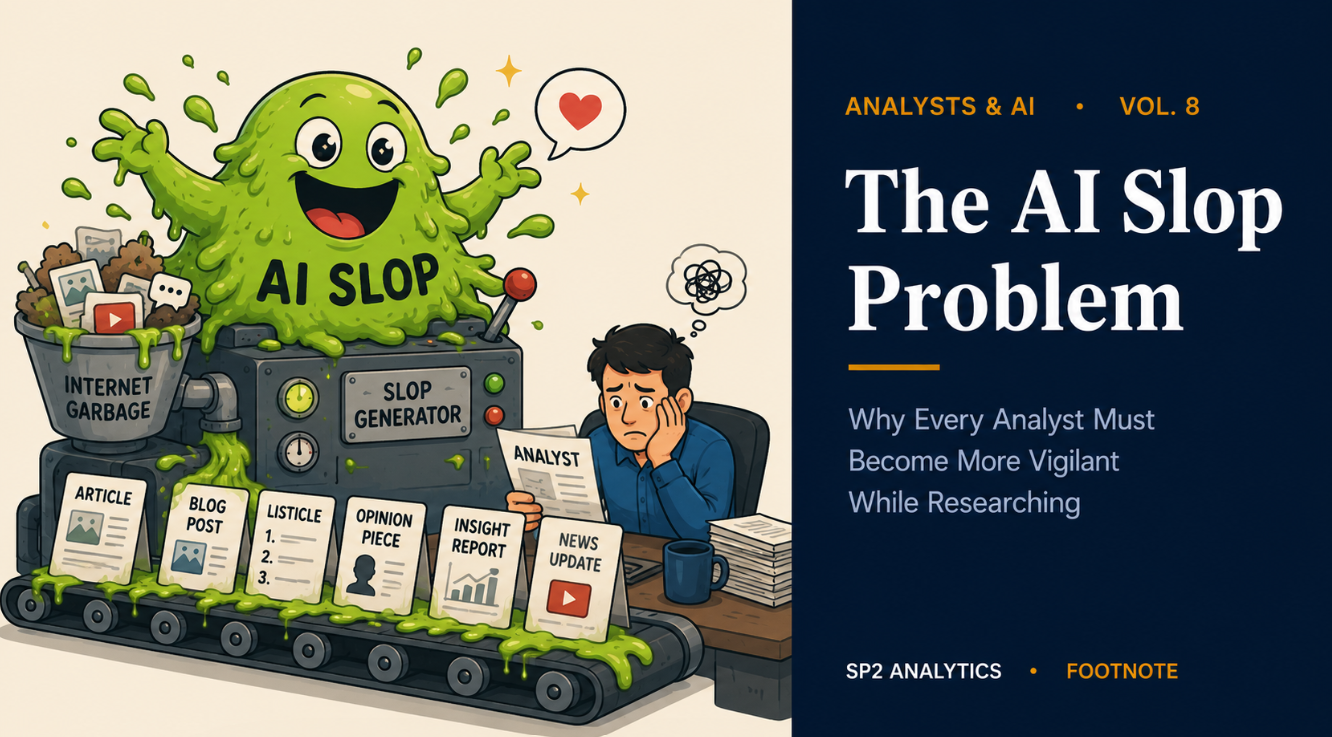
Last month, a colleague forwarded me a video of a well-known celebrity announcing a major shift in their fund’s strategy. Perfect production. Spot-on voice. Natural body language. It took me a while to realise the entire video was AI-generated, a completely fabricated narrative.
And this is no longer just about videos. Fake narratives now arrive dressed as legitimate-looking articles, reports, and “analyst notes”. For investment research, this is not a curiosity. It is a structural threat to the integrity of the research process itself.
In earlier volumes, we covered hallucinations, opinion convergence, and AI chasing narratives. This volume asks a harder question: what happens when the information analysts rely on is itself increasingly AI-generated, and much of it is wrong, fabricated, or deliberately misleading? Welcome to the problem of AI slop.
What Exactly Is AI Slop? Why Is It A Real World Threat

AI slop is mass-produced, low-quality, AI-generated content flooding the internet: articles, reports, social threads, videos, even “analyst notes” that read fluently, use the right jargon, and cite sources that sometimes do not exist.
The scale is staggering. NewsGuard identified over 3,000 AI-generated content-farm websites across 16 languages by early 2026, up from around 2,000 just six months earlier. Many mimic legitimate news outlets, grammatically flawless, logically structured, confident.
Underneath the polish, the data may be fabricated, the sources hallucinated, the conclusions unfounded. For an analyst whose entire job rests on information quality, that is dangerous.
In April 2025, fake news about a supposed delay in US tariffs sent the S&P 500 up 8.5% in about half an hour, temporarily adding $3.6 trillion in market value. The news was fabricated but the market reaction was real.
With retail investors increasingly driven by mobile apps and social media communities, the surface area for AI slop to cause damage is only expanding.
Manufactured Narratives Are Everywhere: From Politics to Markets
AI slop is not random noise. It is increasingly used to build narratives deliberately. Politics shows the playbook: sustained positive coverage, carefully placed interviews, and flattering social content rolled out before a big move. This is a continuous process until a manufactured consensus looks organic. The machinery of perception management is visible to anyone paying attention.
If it works in politics, it works in markets. Imagine AI-generated “analysis” published across seemingly independent websites, blogs, fake expert commentary, bullish “industry voices”, all produced in hours. By the time a real analyst researches the company, ten sources tell the same story. It looks like consensus. It may be one person with a chatbot subscription and a motive.
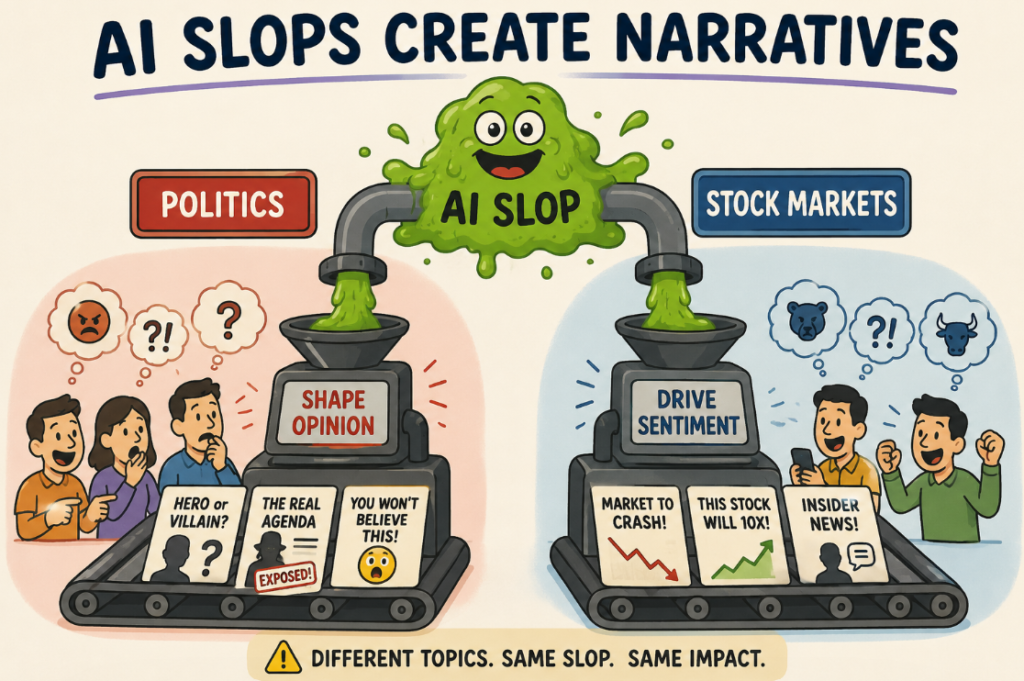
In Vol. 4, we discussed how AI chases narratives instead of fundamentals. Slop makes that exponentially worse: it does not just amplify narratives, it creates them from scratch.
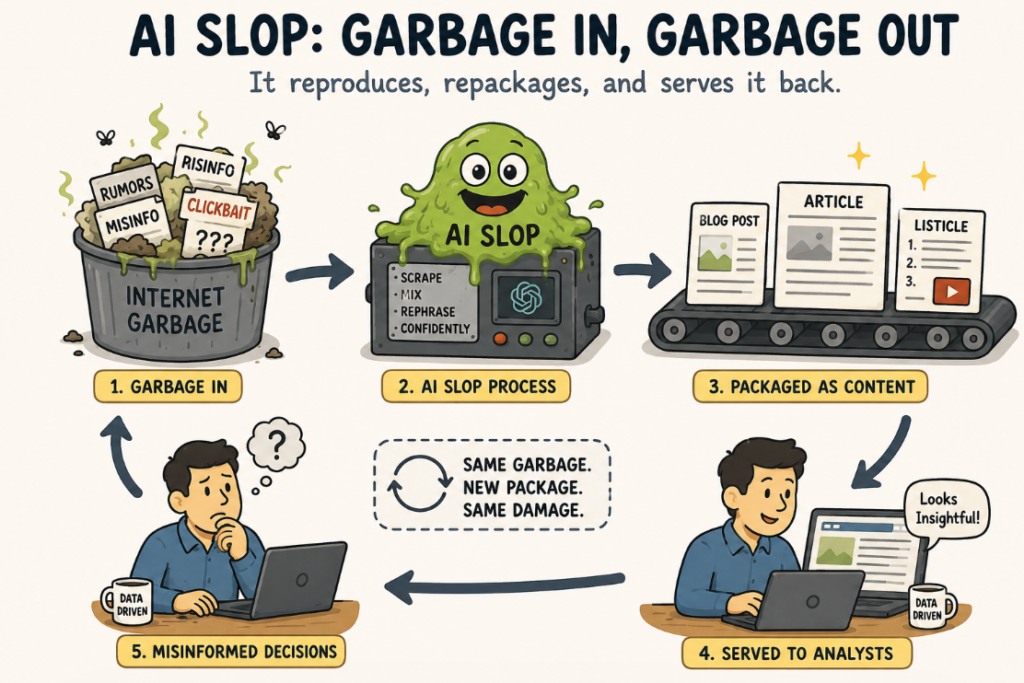
The Cycle of Reproducing Garbage
Here is the loop. An AI-generated article claims a sector faces regulatory headwinds, citing unnamed “industry sources”. Other AI tools scrape and repeat the claim. Soon, five articles echo the same story. The original was fabricated; everything after was AI amplifying AI.
Unlike traditional misinformation, slop has no traceable author, costs almost nothing to produce, and exploits the oldest heuristic in research: “if multiple sources say it, it is probably true.”
What You as an Analyst Should Be Doing Right Now
The uncomfortable truth: every analyst now needs a higher baseline of scepticism. The days of taking a published article at face value are gone. What separates analysts who will thrive from those who will get burned:
- Trace every data point to the primary source. Management quote? Pull the actual transcript. Cited study? Find it. If the primary source does not exist, the data point does not enter your analysis. Spot-checking must become default discipline.
- Distrust consensus that forms too quickly. When five articles say the same thing in slightly different words, ask whether they are independently sourced or echoing one AI-generated origin.
- Ask who benefits. If a narrative around a company or sector materialises out of nowhere, treat it like a PR campaign.
- Prioritise primary research. As discussed in Vol. 6, the analyst who calls the company, attends the investor day, and talks to industry experts builds an information base that an AI slop cannot contaminate.
- Build a trusted source list and stick to it. Regulatory filings (SEC, SEBI, Companies House) are clean. Verified earnings transcripts are clean. High-volume websites or blogs with no editorial oversight are not.
- Demand citations for everything. Any analysis, done by human or AI, must cite sources you can verify independently. If it cannot, treat it as unverified.
For Decision Makers: The Institutional Response
If you run a research team, individual vigilance is not enough. Three institutional safeguards:
- Citation-first AI tools. If your AI tool gives you a number without telling you exactly where it found it, the tool is part of the problem, not the solution.
- Invest in people who can verify. The irony of the AI era: skilled human analysts matter more, not less. A qualified CA, CFA, or MBA can sense when projections do not add up. That instinct cannot be automated; it is your first line of defence.
- Enforce verification in the workflow. No AI-generated content flows into final reports without a human layer: review the output, check citations, validate against primary sources, then incorporate.
How We Are Addressing This at SP2 Analytics and FootNote
For us, this is not theoretical. It is the core design philosophy behind what we build.
FootNote, our AI engine for investment research workflows, makes every insight fully traceable, citations link directly to the relevant filing, transcript, or document section, so outputs are transparent, verifiable, and investment-grade.
SP2 Analytics provides the human verification layer: qualified offshore analysts (CAs, CFAs, MBA Finance) who validate AI outputs, cross-check primary sources, and ensure research quality.
A citation-first AI engine plus qualified human analysts is, in our view, the only sustainable research model in the age of AI slop. Neither alone is sufficient. Together, they deliver speed with trust.
Sample reports and presentations from our analysts: https://sp2analytics.com/sample-work/
Live demo of an automated investment research workflow: https://sp2analytics.com/flash-note-demo/
The Bottom Line
AI slop is not going away. It will get worse: the models are improving, the cost of generation is approaching zero, and the incentives, clicks, manipulation, laziness, are only growing.
For analysts, verification and being more vigilant are no longer a nice-to-have. It is survival. For decision makers, your tech stack and team must assume a significant share of incoming information is unreliable.
Firms that build verification into their DNA will produce research that clients trust. Firms that do not will eventually publish something built on slop, and the reputational damage will cost far more than proper verification ever would.
What Is Your Take?
Have you come across AI-generated content that looked credible but turned out to be fabricated? Has your team changed its verification processes? Have you watched a narrative around a stock build suspiciously fast and wondered if it was manufactured? If you are a decision maker, how are you safeguarding your research process against AI slop?
I would love to hear your perspective, the wins and the frustrations.
This post is published by CA Siddhartha Dongre, founder of SP2 Analytics and FootNote.AI.
SP2 Analytics provides qualified offshore research analysts (CAs, CFAs, MBA Finance) to investment banks, PE firms, VC funds, equity research shops, and consulting companies worldwide. www.sp2analytics.com
With our FootNote solution, we build custom, citation-first AI solutions for investment research workflows.
If you are exploring either side of the equation — whether you need skilled analysts or want to build AI workflow tools for your team — let us talk.
Email: sid.dongre@sp2analytics.com | LinkedIn: CA Siddhartha Dongre
#investmentresearch #equity #equityresearch #investmentbanking #AI #AIforfinance #AIslop #deepfake #misinformation #verification #citation #CA #CFA #privateequity #FootNote #SP2Analytics #AnalystsAndAI