
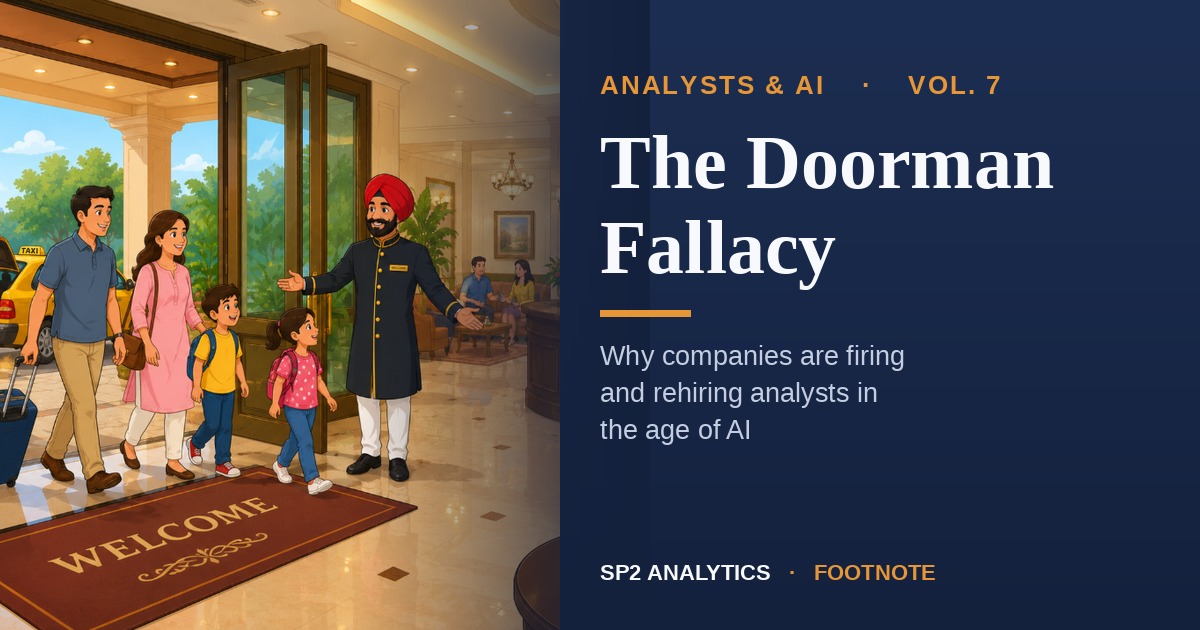
I came across a very interesting concept some time back, which I think is very much relevant in today’s landscape of AI adoption (providing a unique perspective for decision makers who intend to replace analysts with AI, to reduce cost).
A grand hotel decided that its doorman was an unnecessary expense. After all, what does a doorman really do? He only opens the door. The eventual removal of the doorman revealed what was wrong with their approach and the decision they took.
What is the Doorman Fallacy Concept:
A grand hotel decided that its doorman was an unnecessary expense. After all, what does a doorman really do? He opens the door. The decision-makers thought that a door could be opened by a machine at a fraction of the cost. So they installed an automatic door and let the doorman go.
What the hotel discovered was that the doorman had never really been paid just to open the door. He recognised regulars by name and made them feel important and connected to the hotel. He hailed taxis for guests in the rain. He carried bags. He signalled, simply by standing there in his uniform, the kind of establishment you were entering.
The door was the visible 1% of his job. The other 99% only became obvious once it was gone.
This is what is called the Doorman Fallacy: the mistake of defining a role by its most visible, easily measured function, stripping it down to that function, and then trying to automate or eliminate it, only to destroy a large amount of value you never properly accounted for.

I think this is one of the most important mental models for anyone making AI adoption decisions in investment research today.
Problem With Current Adoption of AI
The mistake is not adopting technology; it is defining the job too narrowly. By measuring only what is easy to quantify, organisations overlook the hidden value people create. That value remains invisible until it disappears, often after the capability that produced it has already been removed.
So, when billionaires like Sam Altman and Elon Musk say that humans will no longer work with increased AI adoption, take it with a pinch of salt since they come from a lobby trying to push a particular narrative.
Make no mistake, the error is not in adopting technology. The error is in the definition. You might think like a CTO and measure what was easy to measure, mistake it for the whole job, and automate against an incomplete picture. The value that disappears is invisible precisely because it was never on the invoice. And by the time you notice it is gone, you have already dismantled the thing that produced it. The right thing to do would be to think as an analyst or a client and understand what process flow should be upgraded using AI, and then make a decision.
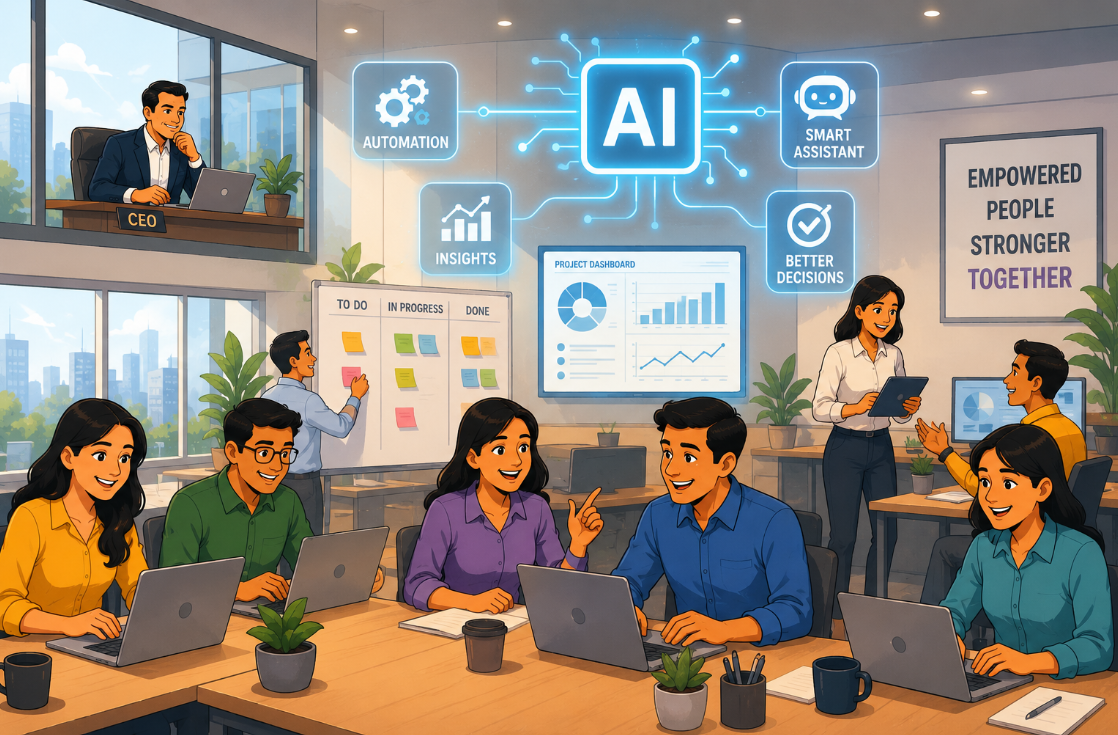
Mapping the Fallacy onto Investment Research Workflow
The dominant narrative is that an analyst’s job is to gather data, build a model, and write up a note. AI can read filings, populate a model, and draft a note in minutes. Therefore, the argument goes, the analyst is largely automatable. Book the savings, remove them from the team.
But “write the note” is the doorman opening the door. It is the visible 1%. Think about what an experienced analyst actually provides on top of that output:
- Judgement on what to trust. Knowing which data point is reliable, which management team has a history of over-promising, and which number in a filing deserves a second look. The analytical line of thinking is the USP of an analyst.
- Knowing what is not there. A CA or CFA reading a balance sheet can sense when something is missing, when financials do not reconcile with the story narrated by the management, and an analyst notices what the management conveniently left out.
- Primary research and relationships. As I argued in Volume 6, the calls to management, the expert interviews, the factory visits, the years of relationship-building, all generate information that exists in no dataset for any model to read.
- Context and the right question. AI answers the question you ask. A good analyst tells you that you are asking the wrong questions and reframes the problem entirely. That reframing is often where the alpha actually sits.
Strip the analyst down to “the person who produces the note,” automate that, and you keep the door-opening while losing the doorman.
The Expensive Round Trip: Fire, Then Rehire
This is precisely the trap a number of decision makers have walked into in the past couple of years. Under pressure to show that they are “AI-forward,” and encouraged by vendors promising headcount elimination, they cut deep, declared victory, and then watched quality, client trust, and institutional knowledge erode. The rehiring that followed was not a small correction; it was an admission that the original analysis of the job was wrong.
In investment research the cost is sharper still, because a single AI-driven error that slips through, an unverified number, a hallucinated source, a missed red flag, can cost a client far more than the salaries you saved. The asymmetry is brutal: the savings are small and certain, the mistakes are rare and catastrophic.
How This Shapes What We Do at SP2 Analytics and FootNote
This thinking is the foundation of how we are built, and I would rather show you the logic than just make the claim.
SP2 Analytics supplies the doorman, the part the machine cannot be. We provide qualified offshore analysts, CAs, CFAs, and MBA Finance professionals, who carry the judgement, the accountability, the primary research, and the instinct for what is not on the page.
With our AI vertical (FootNote), we build you a AI workflow solution for investment research that your doorman can use to enhance the workflow quality and speed.
If you feel the need for any of the above, feel free to connect with me. I will be happy to address your concerns and understand your requirements like a doorman.
The Bottom Line
The Doorman Fallacy is not a warning against automation. It is a warning against careless and unnecessary automation, which leads CXOs to make wrong decisions. AI in investment research is real, powerful, and worth adopting fast. But the analyst’s value was never just “writing the note,” any more than the doorman’s was just “opening the door.”
The firms that win will not be the ones that automate the most. They will be the ones that understand their workflow and people well enough to automate the right things, keep a human accountable where it counts, and see through the narrative that tells them otherwise.
What Is Your Take?
Have you seen the Doorman Fallacy play out in your own organisation/ industry, a role cut because someone defined it too narrowly, and value that quietly disappeared with it? (Share it with management). If you run a research team, where are you drawing the line between what AI handles and what stays with your analysts? And have you felt the pressure from vendors to automate further than your judgement is comfortable with? I would love to hear how this is playing out for you, the wins and the regrets alike.
This post is published by CA Siddhartha Dongre, founder of SP2 Analytics and FootNote.
SP2 Analytics provides qualified offshore research analysts (CAs, CFAs, MBA Finance) to investment banks, PE firms, VC funds, equity research shops, and consulting companies worldwide. www.sp2analytics.com
With our FootNote solution, we build custom, citation-first AI solutions for investment research workflows. https://sp2analytics.com/flash-note-demo/
If you are exploring either side of the equation, whether you need skilled analysts or want to build AI workflow tools for your team, let us talk.
Email: sid.dongre@sp2analytics.com | LinkedIn: CA Siddhartha Dongre
#SP2 #doorman #investmentresearch #equity #equityresearch #investmentbanking #Privateequity #PE #M&A #AI #AIforfinance #doormanfallacy #humanintheloop #automation #futureofwork #CA #CFA #privateequity #FootNote #SP2Analytics #AnalystsandAI #career